Attended ICTER 2024 Conference - Poster Presentation, Organizing Committee Member
Tags: Conference, UCSC, JournalI had the ‘honour’ of being a part of the organizing committee for the annual research conference of UCSC, named ICTER (Ick-ter/tah or I.C.T.-er however you may wanna call it) and the following is a little bit of memorandum of it. (Posting way past the event date)
Hauling Prof. Thiemo
As a part of the keynote committee, my first (and only) task was to go to the BIA on the morning of the 6th, and pick up Prof. Thiemo Voigt and her wife from there and bring them to the Marino Beach hotel, where the conference was happening. Pretty easy task for someone who hasn’t been to an airport all his life. Anyway, went there one and half hours before (keeping up with the Asian tradition), and waited with an A4 paper saying “Prof. Thiemo”. At around 9.30 the couple emerged into the view, we exchanged our greetings and hopped on a pick-me van.
Dr Sandaruwan and his pick-me vouchers
The pick-me part was interesting too. The university has decided to put the burden of transporting to pick-me, so they gave us some vouchers (each Rs.1000) so we can top up our pick-me “points” within the app, and use them as currency. The tricky bit was that Dr Sandaruwan, who was in charge of those had not given them all, or giving them bit by bit to Ms Sanduni, who then scratched those point vouchers and sent us the photos of the codes, that we were supposed to insert into the app. All was well until I had not enough points (money) to pay for the van from BIA to the hotel because more points than we anticipated before were spent on the trip from boarding to the airport. Before the anxiety level rose to 100, Ms Sanduni was kind enough to send the photos of scratched cards, so I topped it up while in the van. phew!
ICTER Proceedings
After saying goodbye to the Professor and Mrs at the hotel entrance, they went to their rooms and I went to the 1st floor where the conference was held. I Met Ms Sanduni and the people, got registered, received the tags with the bands and lunch coupons, and went straight to the hall.
I have missed the first keynote by Dr. Mohamed Nabeel, sadly. His topic was “Securing AI: Navigating AI risks to build a safe digital world”. But I was just in time for the tea break!
Day 1 — Sessions Brief
Technical Sessions — Paper Presentations
- Instruct-DeBERTa: A Hybrid Approach for Aspect Based Sentiment Analysis in Textual Reviews
- They propose a hybrid approach, Instruct-DeBERTa, for Aspect-Based Sentiment Analysis (ABSA). They fine-tune the DeBERTa model on the SemVal 14 dataset using techniques like Peft and SetFit.
- Drug Recommendation system based on Medical Condition Classification and Sentiment Analysis of Drug Reviews
- A drug recommendation system that utilizes a logistic regression model to classify medical conditions based on textual reviews. They also use sentiment analysis to assess the effectiveness of drugs. The presenter discussed the limitations of word2vec, (as to why they did not use it) stating its need for large amounts of data.
- Cash Valuation of Black Tea in the Nuwara Eliya District based on Sensory Quality Attributes: A Case Study
- They have used a combination of dummy and numerical encoding techniques to represent the data. The optimal model is selected based on the Root Mean Square Error (RMSE) metric. Additionally, a Variable Importance Plot (VIP) is used to identify the most influential sensory attributes in determining the tea’s cash value.
- Convergence of Twitter Sentiment Analysis and Optimized Learning Models for Predicting Bitcoin Price Volatility
- They have optimized deep learning models, including BiLSTM and Magnitude CNN, using hyperparameters. VADER is used for sentiment analysis, considering the lag effect. While a voting classifier was initially explored, it was not recommended. The research focuses on both direction and magnitude prediction, with the latter requiring a more granular approach. The Magnitude CNN model outperforms others in predicting Bitcoin price volatility.
- Linguistic Analysis of Sinhala YouTube Comments on Sinhala Music Videos: A Dataset Study
- Did not get much of an idea. However they contribute to the fields of Music Information Retrieval and Music Emotion Recognition by providing insights into how language can be used to infer emotional responses to music.
Keynote by Prof Chris Bain
Professor Chris Bain advocated for interoperability in healthcare, emphasizing HL7 FHIR as a key standard. He discussed innovative solutions like Smart on FHIR and Dosemerx for intelligent data analysis and drug dosage recommendations, as well as the potential of open-source EHR solutions like Open EHR and GNU Health.
Day 2— Sessions Brief
Paper Presentations
- **Utilizing Association Rules in Knowledge Graphs for Enhanced News Summarization
**By combining association rule mining techniques with knowledge graph structures, the model identifies key information and generates concise summaries. The approach leverages techniques like degree centrality, SPO availability, and rough set theory to extract relevant information and improve the quality of summaries.
Missed some other papers…
Keynote by Ludvig Kolmodin — AI in Healthcare (Sponsored)
Ludvig discussed the potential of AI in healthcare, particularly in triage assessment. He highlighted the challenges faced by AI in healthcare, including privacy, security, bias, transparency, regulation, and a lack of understanding among healthcare professionals. Despite these challenges, he emphasized the importance of embracing AI to improve healthcare outcomes.
Keynote by Prof Thiemo Voigt— Towards 6G Ambient IoT with Backscatter and Intermittent Computing
Image via Facebook
Prof. Thiemo Voigt presented a vision for 6G Ambient IoT, emphasizing energy harvesting and intermittent computing. Backscatter communication, inspired by RFID, is proposed to reduce energy consumption. Intermittent computing leverages non-volatile memory to maintain system state, enabling energy-efficient operation. 3GPP standardization is crucial for widespread adoption. TaDA, a task decoupling architecture, is introduced to optimize task execution across multiple MCUs, enhancing performance and energy efficiency. The concept of analog sensor tags, which eliminate the need for MCUs, further pushes the boundaries of low-power IoT devices.
Technical Sessions — Paper Presentations
- Securing IoT Servers: Strategies for Employing Shallow and Deep Neural Networks The research investigates the effectiveness of shallow and deep neural networks in detecting IoT attacks. By preprocessing the UNSW-NB15 dataset and employing hyperparameter tuning, the study trains and evaluates various models. The goal is to identify the most efficient and accurate model for securing IoT servers.
Was away during some paper presentations.
‘I’m a researcher’ Competition
Image via Facebook
Ths years’ competition was a lot intriguing as there was price money for top 3 positions. Participants were a lot more engaged than last year. Hope this concept spreads to other Sri Lankan conferences too.
Me. Image via Facebook
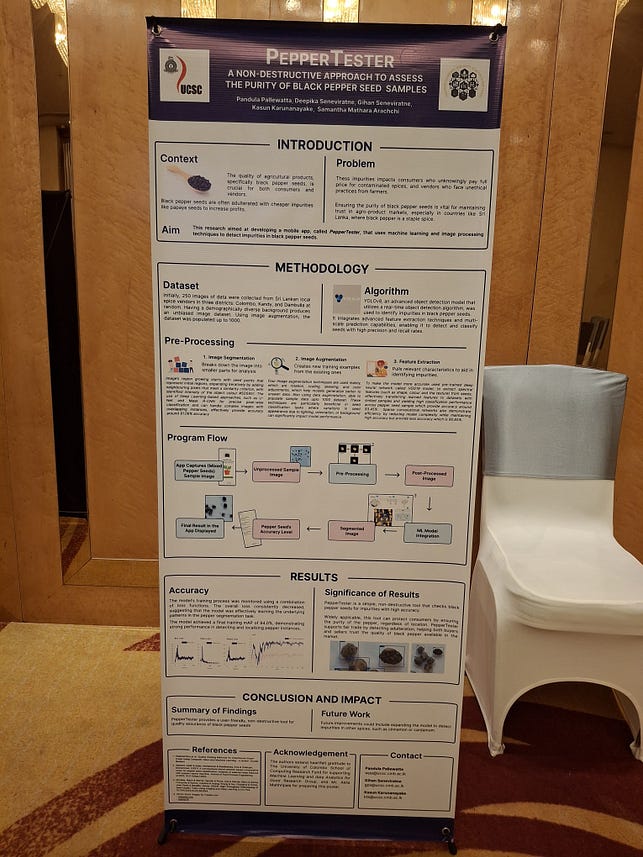 The Poster I created to aid the research (Pepper Tester) by Mr. Pandula Pallewatta, Gihan Seneviratne and others.
Back to top